What is epigenetics?
You have most probably heard about epigentics, although you might not be sure about what it is exactly. Here, I will try to give you a introductory insight on the mechanisms and implications of this type of regulation.
What is epigenetics, then? Well, broadly speaking, it is the reason why the different cells in our organisms, despite containing the same genetic material (except for gametes) present such wide conformations, functions and gene expression patterns.
In 1942, Conrad Waddington coined the concept of a "epigenetic landscape" that would "bring the phenotype into being". This landscape, would, hence, act as a bridge between genotype and phenotype. Two characteristics define epigenetic modifications: the absence of modification of the actual DNA sequence and their heritability after mitotic and meiotic processes.
 The epigenetic landscape as represented by Waddington. This picture aims to repesent each cell as a marble that rolls down a hill with multiple paths; each choice determines the final fate/state of the cell.
Before diving deeper into the different processes involved in epigenetics, some thoughts on Waddington. Simultaneous to his thoughts on epigentics, he described a revolutionary concept, named genetic assimilation. This process implies that phenotypes triggered by environmental conditions are subsequently geneticall encoded. But, wait a minute, isn't this Lamarckism. Some of his contemporary colleagues reportedly thought likewise, and it was a matter of debate for many years, as the "phenotypic plasticity" expressed in this idea dangerously resembles the inheritance of adquired characteristics.
To suppose that the evolution of the wonderfully adapted biological mechanisms has depended only on a selection out of a haphazard set of variations, each produced by blind chance, is like suggesting that if we went on throwing bricks together into heaps, we should eventually be able to choose ourselves the most desirable house.
Waddington CH, 1952
Nowadays, there has been evidence showing that, indeed, genetic assimilation contributes to natural selection.
How do epigenetic processes work?
You must be tired of studying how DNA is packed tightly coiled around histones in two different states, heterochromatin and euchromatin, depending on the accessibility of the transcriptional machinery that they enable. Well, epigenetic modifications are the ones responsible for the shifting between one confomation and the other.
But enough writing about epigenetic mechanisms as a general concept, let's see which are they.
Covalent modifications of nitrogenous bases: 5-methylcytosine
The first category corresponds to covalent modifications of nitrogenous bases. The most widely known and studied modification framed in the former category is the methylation of the C5 of cytosines. Various reviews give a broad insight on the formation and implications of this epigenetic mark, such as this one.
5-methylcytosines (5-mC), in fungi and plants, occur at CpG sites, regions of the DNA where a cytosine residue is followed by a guanine one in the direction 5' → 3'. Although you might have read that this methylation is related to gene silencing, its effect is actually dependent on the genomic region in which it appears: hypermethilation in promoter regions triggers gene silencing, while this same mark in gene bodies can act as either a repressor or an activator of transcriptional activity. In general, the human genome is hypermethylated, except for the regulatory regions controlling the expression of actively transcribed genes.
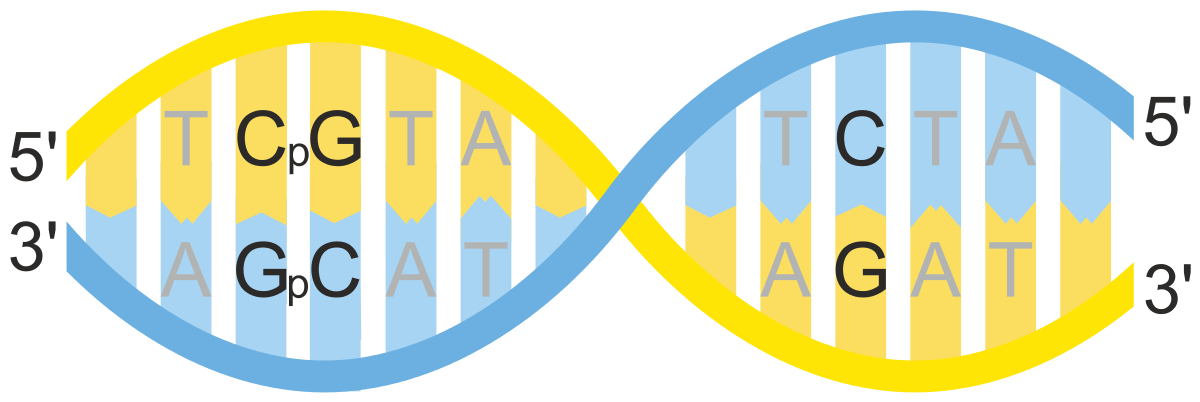 A more visual representation showing what CpG sites are in the genome.
A bit out of scope, but 5-mC can lead to other epigenetic marks following oxidations catalyzed by ten-eleven translocation enzymes, namely 5-hydroxymethylcytosine, which has already being proved to have an effect on regulation, 5-formylcytosine and 5-carboxylcytosine. The latter two have been less analysed, however, recent works are retrieving information on their possible functions in the genome
 A quite complete representation of the methylation/demethylation paths followed by cytosine-derived residues. Black arrows represent active DNA methylation/oxidation, green arrows indicate active demethylation pathways and grey ones, passive demethylations (those resulting from DNA replication which does not conserve methylated bases, at least in a first step).
Covalent modifications of histones
These modifications include mainly methylation, phosphorylation and acetylation. Histone epiogenetic marks are quite complex, as each different type of histone (H2A, H2B, H3 and H4) has different patterns depending on the covalent modification being considered.
The effects provoked by this signatures on gene actvation/repression are as well complex, heavily dependent on the aminoacidic residue suffering the modification.
 Scheme showing a rough explanation on the effect of certain covalent epigenetic modification. The figure also includes the previously commented covalent modifications of nitrogenous bases on the right.