In this page, users can find a list of all available BioExcel Building Blocks workflows. Each workflow has its own
set of WorkflowHub flavours (Jupyter Notebook, CWL, pure Python and Galaxy), along with a set of links for launching it. Links to
documentation and GitHub repository are provided as well.
They can also be found in a
GitHub repository
in all their versions with all the instructions and sample files needed for
executing them at home in the users' own premises.
Have you built a workflow with BioBB and do you want to contribute? We have a specific repository for this purpose. Visit BioBB community workflows and follow the instructions.
Please be sure to use a recent conda version before installing and running our workflows.
Keeping your conda outdated can lead to odd behaviors and incompatibilities,
and consequently, resulting in having to install more dependencies than the
provided in the repository.
GROMACS Protein MD Setup
2026.1
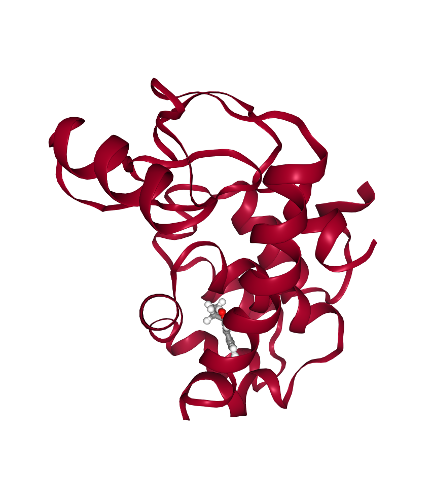
This tutorial aims to illustrate the process of setting up a simulation system containing a protein, step by step, using the BioExcel Building Blocks library (biobb). The particular example used is the Lysozyme protein (PDB code 1AKI).
(*)MyBinder provides a free, online version of Jupyter Lab. Take into account that the provided resources are finite and, in some occasions, it can take a long time to load or to execute your notebooks. Please be patient and don't try to execute several notebooks at the same time.
Automatic Ligand parameterization
2026.1
This tutorial aims to illustrate the process of ligand parameterization for a small molecule, step by step, using the BioExcel Building Blocks library (biobb). The particular example used is the Ibuprofen small compound (3-letter code IBP, Drugbank code DB01050), a non-steroidal anti-inflammatory drug (NSAID) derived from propionic acid and it is considered the first of the propionics.
(*)MyBinder provides a free, online version of Jupyter Lab. Take into account that the provided resources are finite and, in some occasions, it can take a long time to load or to execute your notebooks. Please be patient and don't try to execute several notebooks at the same time.
GROMACS Protein-Ligand Complex MD Setup
2026.1
This tutorial aims to illustrate the process of setting up a simulation system containing a protein in complex with a ligand, step by step, using the BioExcel Building Blocks library (biobb). The particular example used is the T4 lysozyme L99A/M102Q protein (PDB code 3HTB), in complex with the 2-propylphenol small molecule (3-letter Code JZ4).
(*)MyBinder provides a free, online version of Jupyter Lab. Take into account that the provided resources are finite and, in some occasions, it can take a long time to load or to execute your notebooks. Please be patient and don't try to execute several notebooks at the same time.
Mutation Free Energy Calculations
2026.1
This tutorial aims to illustrate how to compute a fast-growth mutation free energy calculation, step by step, using the BioExcel Building Blocks library (biobb). The particular example used is the Staphylococcal nuclease protein (PDB code 1STN), a small, minimal protein, appropriate for a short tutorial.
(*)MyBinder provides a free, online version of Jupyter Lab. Take into account that the provided resources are finite and, in some occasions, it can take a long time to load or to execute your notebooks. Please be patient and don't try to execute several notebooks at the same time.
Protein-ligand Docking (Cluster90)
2026.1
This tutorial aims to illustrate the process of protein-ligand docking, step by step, using the BioExcel Building Blocks library (biobb). The particular example used is the Mitogen-activated protein kinase 14 (p38-α) protein (PDB code 3HEC), a well-known Protein Kinase enzyme, in complex with the FDA-approved Imatinib, (PDB Ligand code STI, DrugBank Ligand Code DB00619), a small molecule kinase inhibitor used to treat certain types of cancer.
(*)MyBinder provides a free, online version of Jupyter Lab. Take into account that the provided resources are finite and, in some occasions, it can take a long time to load or to execute your notebooks. Please be patient and don't try to execute several notebooks at the same time.
Protein-ligand Docking (PDBe REST-API)
2026.1
This tutorial aims to illustrate the process of protein-ligand docking, step by step, using the BioExcel Building Blocks library (biobb). The particular example used is the Mitogen-activated protein kinase 14 (p38-α) protein (PDB code 3LFA), a well-known Protein Kinase enzyme, in complex with the FDA-approved Dasatinib, (PDB Ligand code 1N1, DrugBank Ligand Code DB01254), a small molecule kinase inhibitor used for the treatment of lymphoblastic or chronic myeloid leukemia with resistance or intolerance to prior therapy.
(*)MyBinder provides a free, online version of Jupyter Lab. Take into account that the provided resources are finite and, in some occasions, it can take a long time to load or to execute your notebooks. Please be patient and don't try to execute several notebooks at the same time.
Protein-ligand Docking (fpocket)
2026.1
This tutorial aims to illustrate the process of protein-ligand docking, step by step, using the BioExcel Building Blocks library (biobb). The particular example used is the Mitogen-activated protein kinase 14 (p38-α) protein (PDB code 3HEC), a well-known Protein Kinase enzyme, in complex with the FDA-approved Imatinib, (PDB Ligand code STI, DrugBank Ligand Code DB00619), a small molecule kinase inhibitor used to treat certain types of cancer.
(*)MyBinder provides a free, online version of Jupyter Lab. Take into account that the provided resources are finite and, in some occasions, it can take a long time to load or to execute your notebooks. Please be patient and don't try to execute several notebooks at the same time.
Molecular Interaction Potentials
2026.1
This tutorial aims to illustrate the process of computing classical molecular interaction potentials from protein structures, step by step.
(*)MyBinder provides a free, online version of Jupyter Lab. Take into account that the provided resources are finite and, in some occasions, it can take a long time to load or to execute your notebooks. Please be patient and don't try to execute several notebooks at the same time.
Protein conformational ensembles generation
2026.1
This tutorial aims to illustrate the process of generating protein conformational ensembles from 3D structures and analysing its molecular flexibility, step by step, using the BioExcel Building Blocks library (biobb). Workflow included in the ELIXIR 3D-Bioinfo Implementation Study: Building on PDBe-KB to chart and characterize the conformation landscape of native proteins.
(*)MyBinder provides a free, online version of Jupyter Lab. Take into account that the provided resources are finite and, in some occasions, it can take a long time to load or to execute your notebooks. Please be patient and don't try to execute several notebooks at the same time.
Macromolecular Coarse-Grained Flexibility
2026.1
This tutorial aims to illustrate the process of generating protein conformational ensembles from 3D structures and analysing its molecular flexibility, step by step.
(*)MyBinder provides a free, online version of Jupyter Lab. Take into account that the provided resources are finite and, in some occasions, it can take a long time to load or to execute your notebooks. Please be patient and don't try to execute several notebooks at the same time.
Protein conformational transitions calculations
2026.1
This tutorial aims to illustrate the process of computing a conformational transition between two known structural conformations of a protein, step by step.
(*)MyBinder provides a free, online version of Jupyter Lab. Take into account that the provided resources are finite and, in some occasions, it can take a long time to load or to execute your notebooks. Please be patient and don't try to execute several notebooks at the same time.
AMBER Protein MD Setup
2026.1
This tutorial aims to illustrate the process of setting up a simulation system containing a protein, step by step, using the BioExcel Building Blocks library (biobb) wrapping the AmberTools utility from the AMBER package. The particular example used is the Lysozyme protein (PDB code 1AKI).
(*)MyBinder provides a free, online version of Jupyter Lab. Take into account that the provided resources are finite and, in some occasions, it can take a long time to load or to execute your notebooks. Please be patient and don't try to execute several notebooks at the same time.
AMBER Protein-ligand complex MD Setup
2026.1
This tutorial aims to illustrate the process of setting up a simulation system containing a protein in complex with a ligand, step by step, using the BioExcel Building Blocks library (biobb) wrapping the AmberTools utility from the AMBER package. The particular example used is the T4 lysozyme protein (PDB code 3HTB) with two residue modifications L99A/M102Q complexed with the small ligand 2-propylphenol (3-letter code JZ4).
(*)MyBinder provides a free, online version of Jupyter Lab. Take into account that the provided resources are finite and, in some occasions, it can take a long time to load or to execute your notebooks. Please be patient and don't try to execute several notebooks at the same time.
AMBER Constant pH MD setup
2026.1
This tutorial aims to illustrate the process of setting up a simulation system to run constant pH Molecular Dynamics simulations with AMBER, step by step, using the BioExcel Building Blocks library (biobb) wrapping the AmberTools utility from the AMBER package. The particular example used is the Bovine Pancreatic Trypsin Inhibitor (BPTI) protein (PDB code 6PTI).
(*)MyBinder provides a free, online version of Jupyter Lab. Take into account that the provided resources are finite and, in some occasions, it can take a long time to load or to execute your notebooks. Please be patient and don't try to execute several notebooks at the same time.
ABC MD Setup
2026.1
This BioExcel Building Blocks library (BioBB) workflow provides a pipeline to setup DNA structures for the Ascona B-DNA Consortium (ABC) members. It follows the work started with the NAFlex tool to offer a single, reproducible pipeline for structure preparation, ensuring reproducibility and coherence between all the members of the consortium.
(*)MyBinder provides a free, online version of Jupyter Lab. Take into account that the provided resources are finite and, in some occasions, it can take a long time to load or to execute your notebooks. Please be patient and don't try to execute several notebooks at the same time.
Structural DNA helical parameters
2026.1
This tutorial aims to illustrate the process of extracting structural and dynamical properties from a DNA MD trajectory helical parameters, step by step, using the BioExcel Building Blocks library (biobb). The particular example used is the Drew Dickerson Dodecamer sequence -CGCGAATTCGCG- (PDB code 1BNA). The trajectory used is a 500ns-long MD simulation taken from the BigNASim database (NAFlex_DDD_II entry).
(*)MyBinder provides a free, online version of Jupyter Lab. Take into account that the provided resources are finite and, in some occasions, it can take a long time to load or to execute your notebooks. Please be patient and don't try to execute several notebooks at the same time.
Molecular Structure Checking
2026.1
This tutorial aims to illustrate the process of checking a molecular structure before using it as an input for a Molecular Dynamics simulation.
(*)MyBinder provides a free, online version of Jupyter Lab. Take into account that the provided resources are finite and, in some occasions, it can take a long time to load or to execute your notebooks. Please be patient and don't try to execute several notebooks at the same time.
AutoEncoders for Anomaly Detection
2026.1
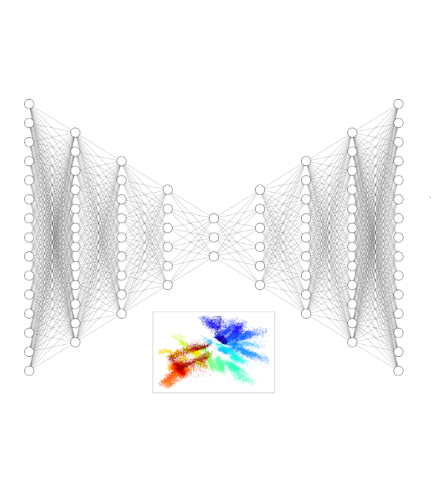
This tutorial involves the use of a multilayer AutoEncoder (AE) for feature extraction and pattern recognition by analyzing Molecular Dynamic Simulations, step by step.
(*)MyBinder provides a free, online version of Jupyter Lab. Take into account that the provided resources are finite and, in some occasions, it can take a long time to load or to execute your notebooks. Please be patient and don't try to execute several notebooks at the same time.
Protein-Membrane MD analysis
2026.1
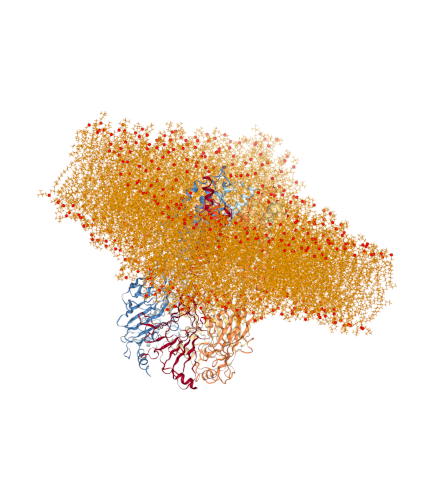
This tutorial aims to illustrate the process of analyzing a membrane molecular dynamics (MD) simulation.
(*)MyBinder provides a free, online version of Jupyter Lab. Take into account that the provided resources are finite and, in some occasions, it can take a long time to load or to execute your notebooks. Please be patient and don't try to execute several notebooks at the same time.
Protein-Protein Docking
2026.1
This tutorial aims to illustrate the process of protein-protein docking, step by step, using HADDOCK3.
(*)MyBinder provides a free, online version of Jupyter Lab. Take into account that the provided resources are finite and, in some occasions, it can take a long time to load or to execute your notebooks. Please be patient and don't try to execute several notebooks at the same time.
This website uses cookies to ensure you get the best experience on our website.
Our Cookie Policy


 Google Colab
  BioBB Workflows